Chain independent
One internal interchain reference
The identifier remains meaningful across the Osnias interchain architecture and does not depend on a chain-native wallet format.
An Internal Interchain Identifier for Multi-Chain Clearing. Release 2.0 introduces a compact 19-digit clearing-account identifier that embeds both the ISO 4217 monetary code and the clearing-cycle duration in weeks, while preserving separation between legal identity, clearing-account identity and technical wallet addresses.
This major release hardens clearing-account identity by binding each Osnias-ID to both a monetary rail and a clearing cycle at creation. The complete 19-digit decimal identifier fits in a single 64-bit unsigned integer (uint64), using the full 8-byte representation on-chain.
Osnias-ID was designed to provide Osnias Clearing with a compact internal reference usable across different escrow-capable blockchain chains, independently of each chain's native addressing system, account model or execution environment.
The identifier remains meaningful across the Osnias interchain architecture and does not depend on a chain-native wallet format.
Clearing messages can transport the Osnias-ID and resolve detailed participant information through the registry where appropriate.
A receivable, invoice or clearing request can reference an Osnias-ID rather than relying solely on a hexadecimal wallet address.
Release 2.0 binds a clearing account to its network, authorized server, monetary unit and clearing cycle directly inside the identifier. Currency and cycle are therefore protocol-level identity attributes rather than mutable off-chain metadata.
KK-NNN-MMM-WW-SSSSSSS-XXThe complete identifier contains 19 decimal digits. Its maximum decimal space remains below 1019, which fits inside an unsigned 64-bit integer. The human-readable decimal representation can therefore be encoded on-chain as a single uint64 / 8-byte value and rendered back into its structured decimal form by the interface.
The clearing account is intrinsically associated with one normalized monetary unit. A USD clearing account cannot be admitted into an EUR, CNY or other monetary clearing rail.
The clearing account is intrinsically associated with its clearing-room duration. A 7-day account cannot be silently routed into a 28-day or 91-day clearing room.
The complete 19-digit OID uses the full 64-bit integer container while remaining human-readable in decimal form and compact in smart-contract storage.
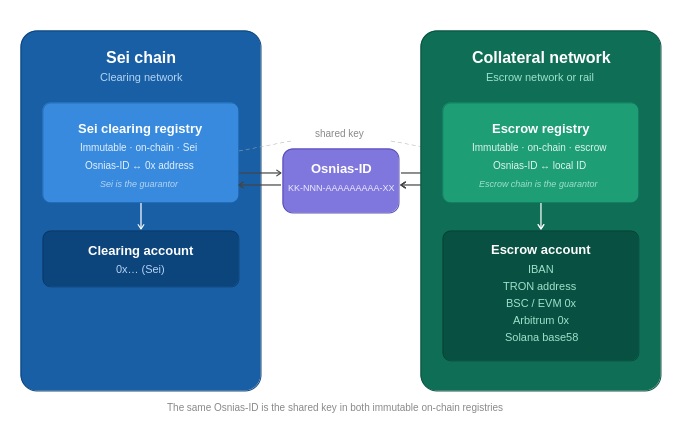
Osnias-ID provides the common clearing reference between the native escrow account on its local network or rail and the corresponding clearing account on Sei. Each escrow network keeps its own native account identifier — for example an EVM 0x address, a Solana address, a TRON address or a banking account identifier — while the Osnias-ID is the shared clearing identifier used by the two registries.
An Osnias-ID is not a company identifier. A company or institution may hold several Osnias-ID clearing accounts, all linked by the Osnias Registry to the same legal entity.
The Osnias Registry is the authoritative resolution layer between a clearing account, its identified participant and its currently authorized operational addresses. Release 2.0 adds two admission invariants before a clearing request can be accepted: the OID monetary code must match the escrow and clearing rail, and the OID cycle must match the target clearing room. Checksum validity alone is never sufficient: the identifier must also resolve to an active and eligible registry record.
The initiating or receiving technical address is resolved against an authorized clearing account.
The system verifies registry status, wallet authorization and applicable network or transaction eligibility rules.
If registry status, checksum, monetary code or clearing-cycle compatibility cannot be resolved and validated, the clearing request is rejected.
KK is the two-digit Osnias network or rail namespace. KK=00 is permanently reserved as a null/unassigned value. Allocated public-network codes identify escrow-capable blockchain environments, while dedicated ranges are reserved for future public networks, institutional rails and Osnias internal infrastructure. A reserved code is a namespace allocation and does not imply integration, validation, participation or endorsement.
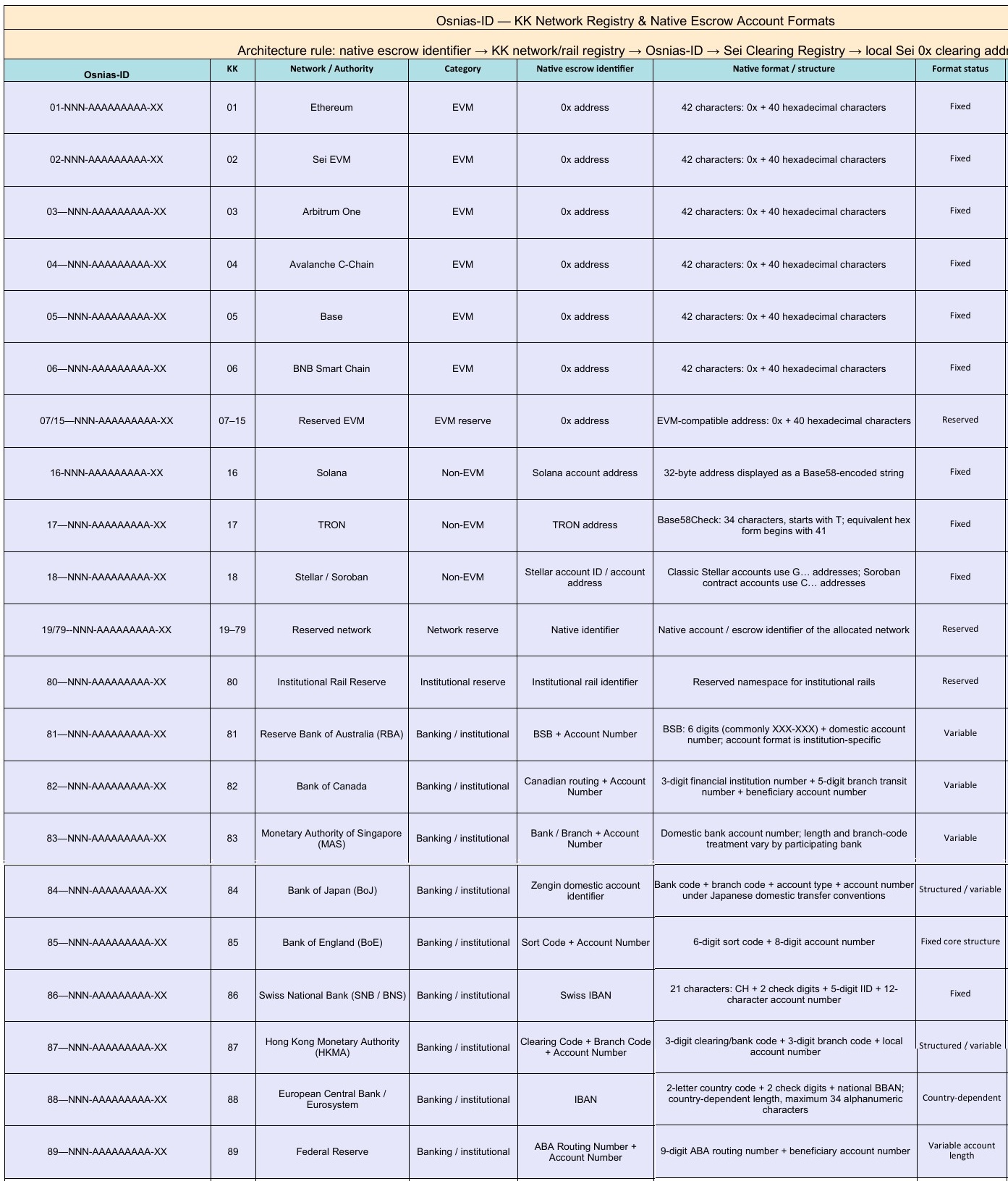
Ethereum, Sei EVM, Arbitrum One, Avalanche C-Chain, Base and BNB Smart Chain.
Solana, TRON and Stellar/Soroban, using their native programmable execution environments.
80–89 are reserved institutional rail namespaces; 90–99 are reserved for Osnias internal infrastructure and protocol functions.
Osnias-ID Release 2.0, dated 11 September 2026, is publicly archived and citable through both HAL and Zenodo. The repository-hosted HAL PDF below is the public Release 2.0 paper corresponding to the current specification.
Osnias-ID is an internal Osnias Clearing identifier and registry reference for interchain clearing. It is not a bank account number, legal-entity identifier, wallet address, regulatory authorization number, security, token or credential of legal status. KK and NNN are allocated by Osnias Clearing; MMM carries the ISO 4217 numeric monetary code; WW records the clearing-cycle duration in weeks; SSSSSSS is allocated by the authorized server inside that server/currency/cycle namespace; and XX is calculated under the Osnias-defined checksum rule. References to ISO 4217, ISO 20022, LEI, UID/CHE, FINMA or other external frameworks are interoperability references only and do not imply certification, regulatory status or endorsement.