Local clearing
Within each node
Obligations between users of the same node are aggregated and cleared locally before inter-node exposure is calculated.
Osnias Clearing is a multi-node clearing network designed to net obligations within each node and across nodes, while each node remains subject to its own jurisdiction.
The network is intended for middle-market economic actors and beyond that exchange recurrently within one area, across several areas or within the same vertical sector. Its purpose is to reduce gross settlements by leaving only the net positions resulting from economic cycles of 1, 4 or 13 weeks to be settled.
Assets remain under client control and under the supervision of node operators in accordance with their jurisdiction. By design, the clearing layer operates on its own blockchain infrastructure and remains strictly separated and isolated from the asset custody and settlement layer.
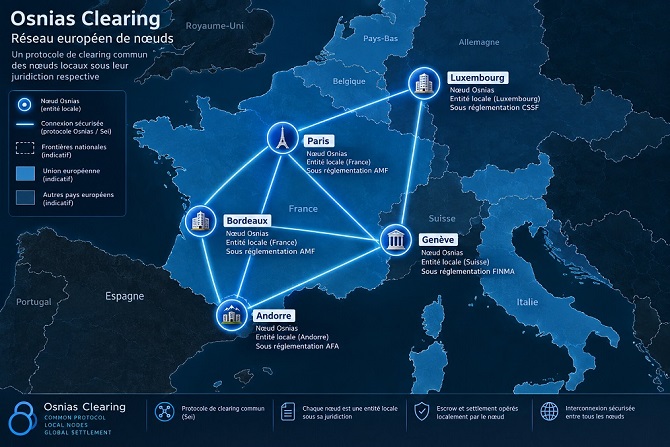
Osnias Clearing is designed to organize multilateral netting of recurring economic obligations between companies and institutions. Its purpose is not to create a new means of payment, but to reduce gross settlement flows, calculate net settlement positions and lower the liquidity required for final settlement.
The network is structured around local nodes. Each node brings together economic actors operating within the same legal or operational environment. Reciprocal obligations are first netted inside the node; only the residual balance is then exposed at inter-node level.
This structure is intended for use within a single economic area, across several jurisdictions, or in vertical sectors where the same firms may successively act as customers, suppliers or counterparties to one another. The model is primarily aimed at middle-market actors and beyond, where recurring flows and reciprocal obligations can justify organized clearing over time.
The protocol uses a common clearing register on Sei to record obligations and calculate clearing positions, while assets used for settlement remain segregated at node level on Ethereum. This separation is structural: Osnias develops the clearing infrastructure but has no access to the escrowed assets used for settlement.
Clearing cycles of 1 week, 4 weeks and 13 weeks correspond to real economic horizons. They give the network time to aggregate reciprocal obligations before calculating the net positions to be settled, first locally and then between nodes.
Osnias Clearing organizes a network of nodes connected to a common clearing register. Each node serves its own users within its legal and operational environment while participating in common clearing with the other nodes.
Obligations between users of the same node are aggregated and cleared locally before inter-node exposure is calculated.
After local clearing, residual positions are aggregated at network level and cleared between participating nodes.
Each node remains a local entity subject to its own regulatory framework while using a common clearing and communication protocol.
The architecture strictly separates the calculation of clearing obligations from the custody of the assets used for settlement.
Sei hosts the canonical clearing register, participant positions, cycles and the states required for netting calculations.
Assets intended for settlement are held separately in escrow on Ethereum at node level. They are not held by the clearing register.
Osnias develops the clearing infrastructure on Sei. By design and by code, Osnias has no access to assets held or escrowed on Ethereum.
Clearing cycles correspond to real economic horizons. They allow reciprocal obligations to accumulate before net settlement positions are calculated, reducing gross settlement flows and the liquidity required for final settlement.
Public documentation and several testnet components are available. The project continues its regulatory review, technical development and security qualification before any production deployment.
Official website and public project documentation.
Technical, institutional, regulatory or partnership enquiries.
Public pages, technical files and project documentation.