Osnias Clearing is not starting from scratch. The project already has a Books I–VII technical corpus, working components on Sei Atlantic-2 and Ethereum Sepolia, and regulatory pre-assessment under way.
The proposed phase funds a jurisdictional Node Stack, then the common Clearing Core, their integration and stress tests, and finally the independent audit. Each accepted milestone unlocks the next tranche. After audit come the complete pre-mainnet regulatory filing, O-POP industrialisation and mainnet.
EXISTING FOUNDATION: elements available before funding | PACKAGES 1–2: development of the two software modules | PACKAGE 3: integration, stress tests & demonstration | PACKAGE 4: independent security audit.
Funding principle. Packages 1 to 4 form one integrated technical PoC funded progressively through milestones. Each tranche funds a verifiable deliverable; milestone acceptance unlocks the next phase. TRLs, eligible expenditure, aid intensity and schemes remain to be qualified with the funding partner.
02 · Founder, market and framework
Founder, market and regulatory framework
Project founder
Osnias Clearing was conceived, designed, organised and documented by its founder, Denis Bouzon, with 100 % self-funding to date. The project has now reached the stage where it needs support to complement the founder’s skills for the next steps: clean code rework, security, the multi-node demonstrator and audit.
Market: a solution that does not yet exist
Osnias offers companies a netting solution that does not exist today. Multilateral netting is a mechanism proven for decades, but reserved for interbank and market infrastructures: as an order of magnitude, CLS and Clearstream together process around EUR 4,300 billion of notional volume per day, i.e. more than EUR 1 million billion per year. Recurring commercial obligations between companies have no equivalent. The aim is therefore not to take a share of an existing market, but to open this mechanism to inter-company flows.
Regulatory framework and risks
The main risk is regulatory: qualification of the infrastructure and of the services provided. Pre-assessment is under discussion with the AMF; the files submitted to the CSSF (Luxembourg) and the AFA (Andorra) are awaiting discussion. The sector is waiting for this pre-assessment before any commitment: until then, exchanges with potential node operators remain exploratory.
Founder’s estimate: around EUR 215k over 6 months for Packages 1 to 4, excluding regulatory Package 5, physical O-POP, mainnet and operation.
03 · Existing foundation
What already exists
The project is not starting from scratch. The work already completed forms the foundation from which Packages 1 to 4 of the PoC can be qualified, budgeted and matched to suitable funding schemes.
Area
Elements already in place
Status / scope
Technical documentation
Structured Books I–VII technical corpus covering the architecture, Osnias-ID, clearing cycles, security and rules, onboarding and the O-POP / RPC architecture. Related position papers and public documentation.
Documentation baseline available; to be kept aligned with the technical baseline.
Draft testnet development
Eight working draft components: 1W time oracle, Sei registry (identity), Sei controller and position ledger on Sei Atlantic-2 (Sei contracts verified); Node Registrar, EVM registry, EVM escrow and controller on Ethereum Sepolia; Osnias Clearing Desk platform online. Details: osnias-clearing.com/deployment/ and /end-user/.
Draft development on testnet; code to be reworked (Cursor AI → Foundry → Slither) before audit.
Preparatory regulatory work already completed across three jurisdictions.
Ecosystem & third parties
Exploratory contacts with banking, fintech and infrastructure / technology players, as well as other institutional stakeholders.
Exploratory contacts and exchanges only; no partnership or consortium is presented as committed.
Outreach & traceability
Public website, summary FAQ, FR / EN documentation, architecture diagrams and technical publications enabling a third party to assess the project quickly before accessing detailed documents.
Qualification material for technical partners and authorities.
For a funder: the funded phase covers two distinct software modules — the jurisdictional Node Stack followed by the common Clearing Core — then integration / stress testing and the independent audit.
04 · Draft testnet
Components already developed in draft (testnet)
The components below are deployed on testnet in draft development: they will be reworked through a clean development chain before the baseline is frozen and audited.
Component
Network
Status
What works
1W time oracle
Sei Atlantic-2
Deployed, verified
Weekly cycle, clearing-cycle states and windows, cycle number and start block.
Sei registry (identity)
Sei Atlantic-2
Deployed, verified
Identity of participants and nodes on the clearing side.
Sei controller
Sei Atlantic-2
Deployed, verified
Links oracle, registry, clearing positions and the Sepolia EVM chain.
Clearing position ledger
Sei Atlantic-2
Deployed
Recording of obligations and clearing positions; instructions and cycle controls.
Node Registrar
Ethereum Sepolia
Deployed
Registration of KK-NNN nodes (first node: 90-017).
EVM registry
Ethereum Sepolia
Deployed
KK zone registry on the EVM side.
EVM escrow & controller
Ethereum Sepolia
Deployed
Collateral escrow and control on the EVM side.
Clearing platform (Clearing Desk)
Sei Atlantic-2
Online, draft
Wallet connection, ledger position, oracle state, function availability by window, registry.
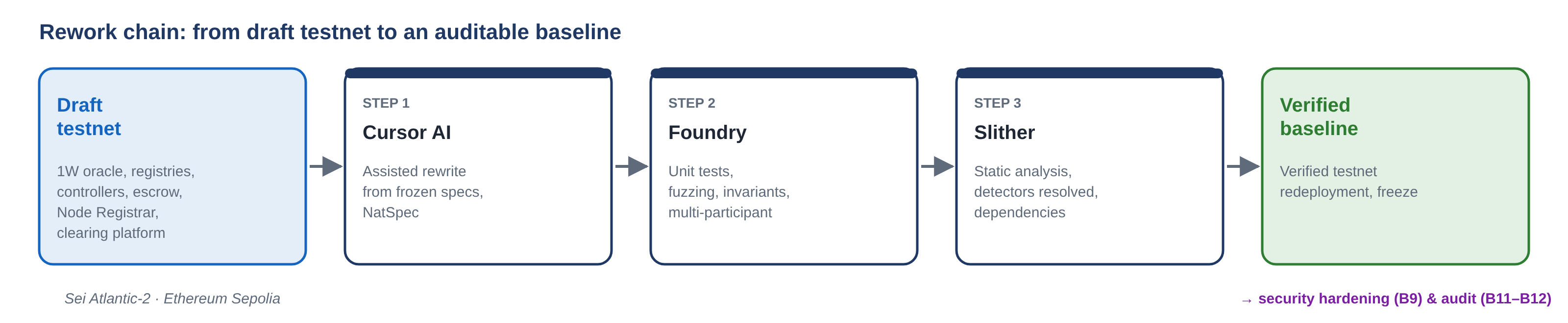
The tool matters less than the framing: each component is reworked in strict conformity with the technical specifications of Books I to VII.
Cursor AI — assisted rewrite of the draft code from frozen specifications, consistent conventions, NatSpec documentation.
Foundry — unit tests, fuzzing, invariant tests and multi-participant simulations.
Slither — static analysis, detector review and remediation, dependency review.
Verified testnet redeployment, then freeze of the baseline handed over to security hardening and audit.
Figure 1 — Rework chain: from draft testnet to an auditable baseline
05 · Documentation corpus
Documentation corpus — Books I to VII
The technical corpus is published as seven books, each available in French and English on the public website and archived on Zenodo with a permanent DOI.
The Node Stack is jurisdictional and carries onboarding, local compliance and node-side EVM functions. The Clearing Core is transversal and common to all jurisdictions; Sei remains the reference deployment, with network dependencies isolated in an adapter.
Separation principle. The Node Stack decides who is admitted and applies the local framework. The Clearing Core runs clearing once the participant is admitted. Package 3 stress-tests the integrated system; Package 4 audits it.
Package 1
Jurisdictional Node Stack — Ethereum / EVM
TO DEVELOP ON THE EXISTING EVM FOUNDATION — JURISDICTION-SPECIFIC
Purpose: deliver a testnet node able to admit a company, establish its technical identities and accounts, register its Osnias-ID and operate the required EVM functions under applicable local rules.
Company onboarding: KYB/KYC/AML, representatives, beneficial owners, admission statuses and evidence.
Business backend: SQL database, API / PHP modules or equivalent, onboarding state management and audit trail.
0x-account provisioning and company ↔ Osnias-ID ↔ node ↔ currency ↔ cycle mapping.
Node Registrar, EVM registry, escrow and controller on Ethereum testnet; entry/exit controls and events required by clearing.
Node-operator interface: admission, suspension, exit, collateral, alerts and operational status.
VPN account / identity provisioning for the future O-POP; physical O-POP deployment remains outside the pre-audit PoC.
Local conversion / settlement interfaces prepared as integration points, without imposing one regulatory model across jurisdictions.
Milestone 1 — exit criterionA reference jurisdictional Node Stack works end-to-end on testnet: onboarding → 0x accounts → Osnias-ID → EVM, with logs and node-operator interface.
Package 2
Common Clearing Core — Sei reference deployment
EXISTING TESTNET DRAFTS — CLEAN REWORK, INTEGRATION AND EXTENSION
Purpose: build the common transversal clearing structure, independent of node-local law and replicable for each currency.
Multilateral netting engine, canonical clearing ledger and consistency invariants.
Three chambers per currency: 1W, 9W and 13W, each with cycle states, recording, clearing, escrow adjustment and settlement rules and a dedicated end-user interface.
1W / 9W / 13W time oracles and clearing-side solvency oracle; redundancy, freeze and recovery policies.
Clearing-side Osnias-ID and mapping to admitted nodes.
Clearing-side ISO 20022: mapping of Osnias events, orders, confirmations, statuses and error handling.
Sei ↔ Ethereum cross-layer reconciliation, divergence detection and fail-closed behaviour.
Core built on standard EVM primitives with a Sei adapter; future portability and migration / multi-deployment without rewriting business logic.
Clearing-side O-POP interfaces and specifications; physical O-POP installation takes place after Package 5, during industrialisation.
Milestone 2 — exit criterionThe common Clearing Core runs all three 1W / 9W / 13W horizons on testnet, with chamber interface, netting, oracles, ISO 20022 and reconciliation operational.
Package 3
Integration, Stress Tests & Demonstration
SYSTEM VALIDATION — NOT A THIRD BUSINESS MODULE
Purpose: connect several Node Stacks to the Clearing Core, run complete cycles and expose the system to nominal, load and failure scenarios before audit.
Demonstrator with at least three nodes and several simulated participants.
Complete 1W / 9W / 13W cycles and flow datasets of different sizes.
Load stress: number of obligations, event frequency, state changes and cycle windows.
Sei / Ethereum desynchronisation, delayed or unavailable oracle, connection loss, latency and recovery.
Systematic validation of fail-closed behaviour, logs, evidence and recovery procedures.
Measurement of the netting rate and production of reproducible metrics for the audit package.
Milestone 3 — exit criterionSeveral multi-node cycles are executed and documented; failure and stress scenarios are reproducible; no known critical issue remains open before audit.
Final security hardening: static analysis, fuzzing, dependencies, access controls, DoS and attack surfaces.
Independent audit of smart contracts and critical components within the agreed scope.
Remediation plan, fixes and auditor re-test.
Milestone 4 — exit criterionIndependent audit report delivered; vulnerabilities addressed; remediation re-tested; audited baseline frozen for the complete regulatory filing.
07 · Timeline & funding
Indicative EUR 215k over ~6 months, milestone by milestone
Founder’s estimate for the integrated PoC. Amounts are indicative and must be refined against eligible expenditure, aid intensity and selected co-funding.
Common core: netting, 3 chambers / currency, end-user, oracles, ISO 20022, reconciliation.
M2 acceptance → Package 3 funding
PACKAGE 3 — Stress & Demo
M4–M5
EUR 45k
Multi-node demonstrator, complete cycles, load, failures, metrics and netting rate.
M3 acceptance → Package 4 funding
PACKAGE 4 — Security Audit
M5–M6
EUR 40k
Frozen baseline, independent audit, remediation and re-test.
M4 acceptance → opens regulatory Package 5
Total Packages 1 to 4: EUR 215k. The exact payment profile within each tranche — advance, interim payment, acceptance balance — will be defined with the funder(s).
PoC funding architecture
A milestone may be funded by one or several contributors: public grant, private co-funding or industrial partner. A contributor may participate in one tranche or several, allowing the PoC to be funded progressively without requiring a single funder.
For strategic private co-funders, a later equity investment in the future operating company may be negotiated separately. PoC funding and equity investment remain distinct transactions; participation in the PoC does not automatically confer equity rights.
After the PoC: regulatory filing, O-POP and mainnet
Package 5
Complete pre-mainnet regulatory filing
Submit the complete file with audited baseline, stress-test results, procedures and security evidence. Continuation of the AMF pre-assessment already under way: the authority reviews a known and pre-assessed project, now supported by its audited baseline.
Applicant, adviser, procedure and cost: to determine after pre-assessment feedback.
Package 6
O-POP & industrialisation
Physical deployment of the clearing-side O-POP: servers / private RPC, VPN, DMZ, logs, monitoring, hardening and acceptance, jurisdiction by jurisdiction.
Outside Packages 1–4 PoC; to be costed per jurisdiction.
Package 7
Mainnet
Production deployment of the Clearing Core on reference Sei and EVM components on Ethereum; activation of authorised nodes. The core remains chain-agnostic and portable.
Outside PoC; deployment and operating budget to be costed.
Expected work with an innovation funding partner
Qualify entry / exit TRL for each Package, without imposing one TRL on the whole project.
Refine indicative budgets against genuinely eligible expenditure and aid intensity.
Identify French, European or local schemes suited to each milestone.
Structure tranche sequencing and acceptance / release conditions.
Identify useful co-funders or technical partners; allow an actor to fund a specific milestone.
Where relevant, prepare the separate articulation with strategic investors in the future operating company.
Prepare the post-audit transition to regulatory Package 5, then O-POP industrialisation and mainnet.
Purpose. Fund one integrated PoC through verifiable milestones: jurisdictional Node Stack → common Clearing Core → integration & stress tests → audit; then submit the complete regulatory file for a project already pre-assessed before O-POP industrialisation and mainnet.
Technical information. This roadmap describes an integrated PoC hypothesis and an indicative budget; TRLs, eligible expenditure, aid intensity, funders, timeline and release conditions remain to be qualified. It does not constitute an offer of securities, investment advice or a solicitation.