01 · Onias III
Legitimacy, stewardship and the pursuit of justice
Onias III served as High Priest of the Jerusalem Temple in the second century BCE, approximately
from 187 to 175 BCE. The historical tradition presents him as one of the last legitimate high priests
of the Zadokite line. The Second Book of Maccabees is reported as describing him as a good man who
sought justice.
Legitimacy
Zadokite continuity
Onias III belonged to the Oniad high-priestly family associated with the Zadokite line.
His removal from office took place in a period when religious authority, political power
and royal intervention were increasingly entangled.
Integrity
A reputation for justice
Ancient tradition preserved in the sources portrays Onias III as a good man committed to justice.
This reputation is central to the historical memory adopted by Osnias Clearing.
Stewardship
Custody of entrusted wealth
As High Priest, Onias III was connected with the administration and protection of the Temple treasury,
including funds deposited there by third parties. His office therefore carried both religious and civil responsibility.
Historical point.
The surviving sources support Onias III's high-priestly office, his association with the Temple treasury,
and his reputation for justice. They do not establish that he personally operated a modern-style clearing register.
02 · Onias IV
Leontopolis: continuity beyond Jerusalem
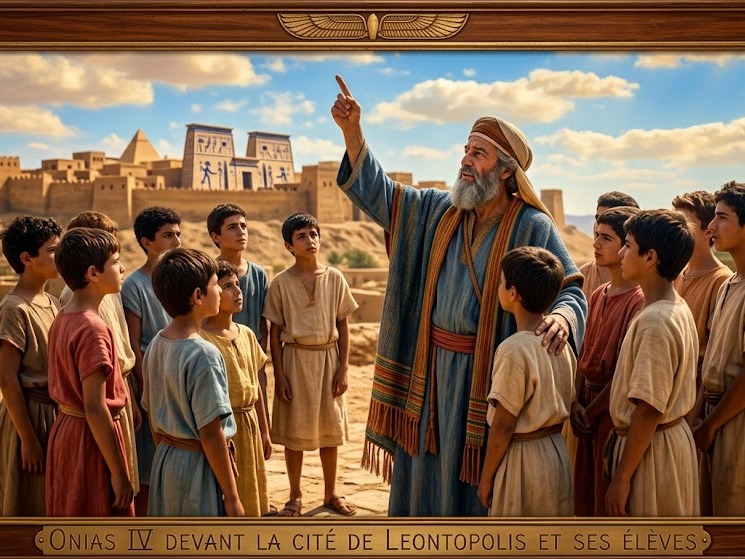
Onias IV, son of Onias III, left Judea for Ptolemaic Egypt. With the permission of Ptolemy VI,
he established a temple in Egypt, traditionally dated to the middle of the second century BCE.
The sanctuary became known as the Temple of Onias and gave the Oniad tradition an institutional
continuation outside Jerusalem.
Transmission
From father to son
Onias IV inherited the prestige and expectations attached to the Oniad high-priestly family,
even though the high priesthood in Jerusalem passed into other hands.
Leontopolis
A new institutional center
In Egypt, Onias IV founded a temple modeled on the Jerusalem sanctuary.
The site associated with this temple is Tell el-Yahudiya, one of the places historically called Leontopolis.
Continuity
An Oniad community in Egypt
Sources describe an Oniad presence in Egypt that acquired political and military importance,
with territory later remembered as the “land of Onias.”
03 · Historical Continuity
Jerusalem, Antioch and Egypt
c. 187–175 BCE
Onias III as High Priest
Onias III holds the high-priestly office in Jerusalem and is associated with the last known
phase of recognized Oniad/Zadokite high-priestly legitimacy.
c. 171–170 BCE
Death of Onias III
After his deposition and exile, Onias III is killed near Antioch.
His death becomes part of the memory of a displaced legitimate priestly order.
Mid-2nd century BCE
Onias IV in Egypt
Onias IV establishes the Temple of Onias in Ptolemaic Egypt, creating a durable institutional
expression of the Oniad tradition outside Judea.
Until 73 CE
The Temple of Onias remains active
The Egyptian sanctuary survives for more than two centuries before being closed by order of Vespasian.
04 · Qumran & the Zadokite Memory
A historical connection — but not a proven direct transmission
The Qumran communities and the Dead Sea Scrolls preserve a strong Zadokite identity and a pronounced concern
for ordered sacred time. Some twentieth-century scholars proposed identifying Onias III with the
“Teacher of Righteousness” mentioned in the Qumran texts. That identification was once influential,
but it has largely been abandoned and remains unproven.
Source discipline.
The cited historical sources do not prove that Onias III or Onias IV personally transmitted
the 364-day calendar, Jubilee rules, or a specific system of registers to Qumran.
Osnias Clearing therefore treats this relationship as an intellectual and symbolic lineage,
not as a demonstrated chain of documentary transmission.
05 · Time, Record and Word
The institutional meaning adopted by Osnias Clearing
In the ancient high-priestly world, the Temple was not only a sanctuary. It was also an institution
in which entrusted wealth, obligations, public authority and sacred time converged.
Osnias Clearing draws from this historical setting three modern principles.
Record
Keep an accountable register
A clearing system must preserve a traceable and reconcilable record of positions.
The register is not the wealth itself; it records claims, movements and settlement states.
Word
Honor commitments
Clearing transforms reciprocal promises into an ordered process of reconciliation.
The protocol gives participants time to perform, exchange and offset positions before final settlement.
Time
Give settlement a rhythm
Osnias Clearing treats time as part of economic architecture.
Immediate computation does not require immediate final settlement.
06 · The Jubilee Clearing Legacy
A modern clearing rhythm inspired by periodic release
Osnias Clearing does not reproduce an ancient legal calendar. It translates the Jubilee idea
into a modern operational principle: economic positions should have time to circulate and compensate,
while the system periodically closes, reconciles and releases.
Modern doctrine.
Value is created by circulation, reciprocal exchange and compensation over time — not by the clearing token itself.
The 91-day cycle is therefore a deliberate economic breathing space, not a technical delay.
07 · Why the Name Osnias Clearing?
Walking in the footsteps of an institutional tradition
The name Osnias Clearing is a deliberate reference to the Oniad tradition: integrity in office,
responsibility for entrusted value, continuity of institutions and disciplined treatment of time.
The protocol translates those themes into an EVM clearing architecture designed for the twenty-first century.
Ancient inspiration
Integrity, stewardship and ordered time
Onias III and Onias IV belong to an historical world in which priestly legitimacy,
entrusted assets and institutional continuity were inseparable from the ordering of communal life.
Modern implementation
Registry, clearing and periodic reconciliation
Osnias Clearing uses blockchain infrastructure to record positions, reconcile them over time
and settle residual balances through explicit clearing cycles while separating clearing from custody, lending and credit.
08 · Historical Sources
Sources used for this page
The historical statements on this page are based on the following public reference articles.
Interpretive passages describing the philosophy of Osnias Clearing are explicitly modern and should not be read as claims about ancient technical practice.
Onias III
High priesthood, Zadokite lineage, Temple treasury, reputation for justice and the debated Qumran hypothesis.
Open source ↗
Onias IV
Migration to Ptolemaic Egypt, foundation of the Temple of Onias and the Egyptian Oniad community.
Open source ↗
Leontopolis
Geographical and historical context for the Egyptian sanctuary associated with Onias IV.
Open source ↗